


Personal Fashion Favorites + Developing Personal Style in a Global Community
- Lily
- Mar 16, 2020
- 7 min read
When I was little, I always imagined that I’d grow up to be tall like my mom. She’s nearly six feet tall, and so it was disheartening when my yearly doctor appointments revealed that I’d stopped growing after seventh grade, falling just short of five foot five. Maybe I’ll have a growth spurt in high school I told myself as I watched my two younger sisters shoot past me inch by inch. But here I am, not having gained a fraction of an inch in years. For a while my status as the shortest member of my family annoyed me - it’s simply not fair that I, the oldest sibling, should have a stature that suggests a direct opposition to that role! But over time I not only accepted my height, but grew to see the positive effects of it. For the first time in my life, I didn’t have to get rid of clothes because I’d outgrown them, and even though it was initially embarrassing to receive hand-me-downs from my little sisters, I realized that finishing growing early meant that I could work on building a closet of clothes that I could wear and treasure for years to come.
I’ve always enjoyed finding and buying clothes that speak to me; in elementary school I was obsessed with patterned Mini Boden dresses that I wore with cute warm tights, in middle school I developed an affinity for collared shirts and blazers and walked around like a tiny business woman. In high school I realized the importance of a comfortable pair of jeans. Today I’ve got shoes that I bought for gym class all the way back in seventh grade, the dress I wore to my first homecoming dance, even the skirt I wore on my first ever date. Clothes are important to me because they allow me to look good and feel confident, but also because they have memories connected to them. The clothes that have remained in my closet the longest aren’t the ones I bought on a whim shopping trip but instead the ones that were given to me or picked out after what my mother would probably describe as too-long shopping trips, where I try and retry on various pieces and imagine how they’ll fit into my existing collection of garments. They aren’t always the “trendiest” pieces available in stores, but ones that have a longer shelf-life of attractiveness, and I think that, contrary to what you might expect, it’s this factor that’s allowed me to maintain a fashionable appearance over time. Even though I may not always be sporting the newest trends (which seem to come and go faster than I can even keep up,) I look good because I buy clothes that speak to me, and fit in with the clothing that I already own, forming a cohesive wardrobe that I can match and pair for a long time.
"Fashion changes, but style endures" - Coco Chanel
That brings me to this post: developing your own sense of style isn't something that interests everybody, but I think that something as simple as choosing a favorite color palate for your clothes so that your wardrobe has a sense of cohesion and unity can actually allow you to think about fashion even less - everything you own will go together without any further thought on your part! If you're more like me, clothes and style are really important to you and cultivating a closet of pieces that you love to wear is a tribute of self-care. Clothes can be a neutral part of your life or a source of joy, but they should never be a burden! So take your personal fashion collection beyond the constantly-shifting trends of fast fashion, and invest in the trend that never dies: looking good in clothes that can bring you comfort for years and years.

Rethink the T-shirt: as a young girl I hated T-shirts because in my mind they were the most boring thing you could wear - so boxy and plain! As I've grown older however, I've realized that sometimes you just want to be comfortable, and T-shirts are the perfect answer for this desire. But being comfy and being cute shouldn't be mutually exclusive! These shirts are simple enough that you can throw them on for a laze-around the house day, but aren't so casual that you'd be embarrassed about wearing out and about. If you can't be comfy at home, take the comfy with you!
Heavenly Blue: oh how I love pastels! This

clockwise from upper left: "In Love" shirt from Lanius, "Danse Ivy" shirt from Thinking Mu, "Cutre Heart" shirt from Thinking Mu, "Cut Out Thin Strap" bra from The-Acey, all in organic cotton
board is an ode to delicate powder blue, the color of the sky on an early spring day after a week of rain showers. Even if you like the rain, a clear blue sky will always lift your spirits. Radiant skin is always a wonderful accessory, so be sure to drink plenty of water from your reusable water bottle - as soon as I got one of my own, my water intake went way up, and it's so convenient to have around.
Greener Grass: this peacefully minty lookbook is the perfect opportunity for me to introduce the factor that ties all of the clothes on these moodboards together. Each

clockwise from upper left: "Stevie Petal Shirt" from Stella McCartney, (organic cotton and silk), "We Are Water" shirt from Lanius (organic cotton), "32 oz Widemouth Bottle" Hydroflask [color no longer available, closest is "Fog"], "Dirty Denim 'The Perfectly Imperfect Jean'" from Rêve En Vert (reclaimed jeans)
piece in these collections is made out of sustainable materials who's negative environmental impacts are lower than those of traditional clothing materials like "regular" cotton and polyester. So often we think of "earth-friendly" fashion as being sort of hippy-esque; not easily incorporated into the average person's closet. I'm here to put that idea to rest! These pieces are all totally wearable, and the care that goes into making a product better for the earth means that it'll also be better for you, giving you long-lasting
outfit staples that you can feel good about styling for years to come.

from top to bottom: "Lucid" album by Raveena, "Bite the Bullet Jumpsuit" from Maggie Marilyn, "Fortune Cookie T-Shirt" from Stella McCartney, "Pink Grape Faille Shirt" from BODE (up-cycled tablecloth), "Nice Ramie Cropped Jacket" from Dressarte Paris (ramie), "Batsheva" dress from Need Supply Co. all organic cotton unless otherwise noted
Busy Bee: it's pretty well known that black is a universally flattering color, but mustard yellow is a less popular color that can be worn at any time of the year. Cool Autumn breezes whirling through the trees? Throw on a goldenrod shirt that brings to mind crisp fallen leaves and quickly ripening squash. Spring heating up? Try this flowing yellow maxi-dress reminiscent of fields of dandelions and marigolds. A pop of honey can do no wrong.
Unsent Letters: Dusty creams and pinks have an ageless air of elegance. These pieces are perfect to wear on a flirty date, or to be
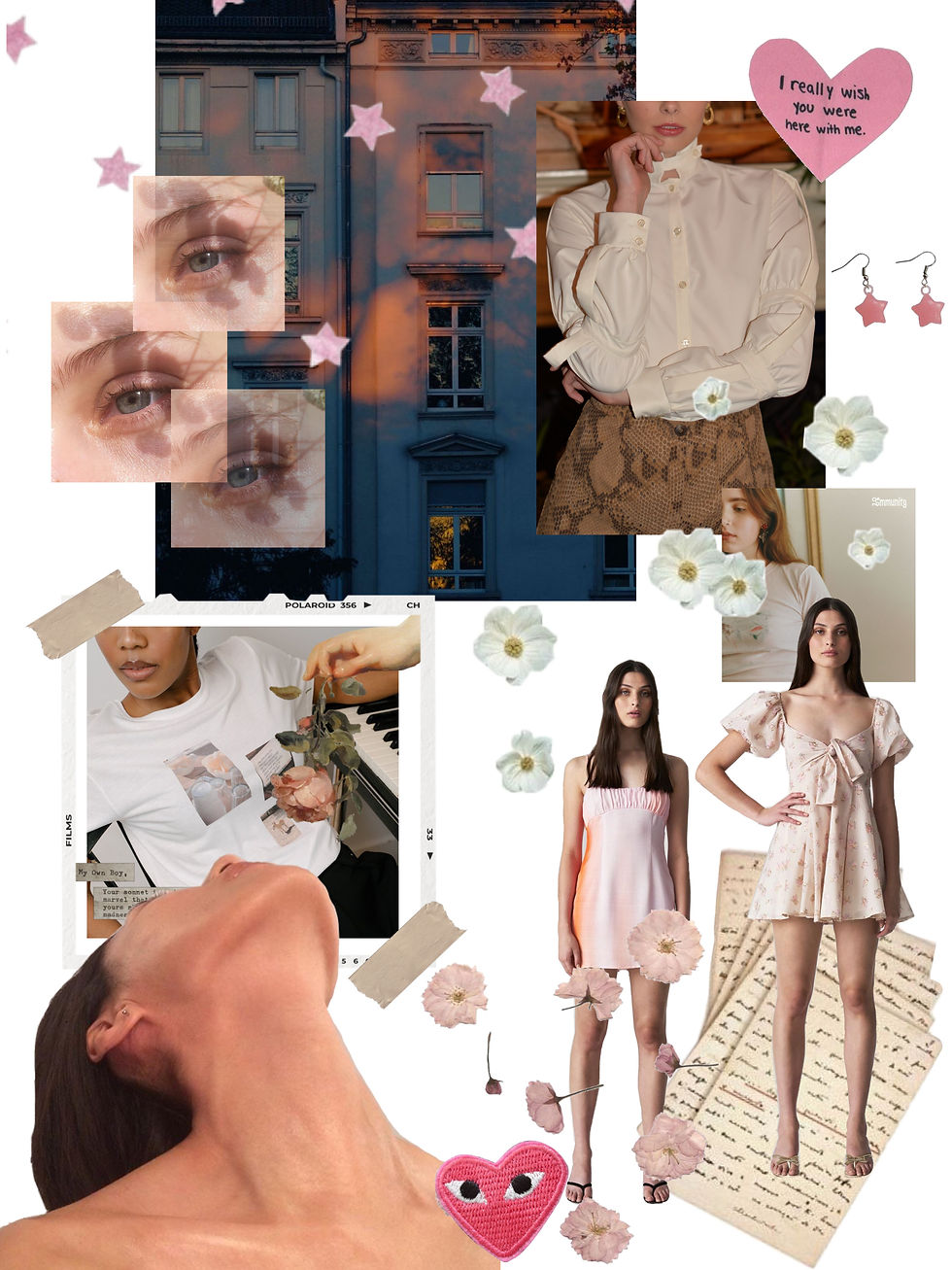
clockwise from upper left: "KLIED with Lace" from Lanius, "Relax Rose - Dip Black" jeans from GatherandSee (organic and post-consumer recycled cotton), "Morgan Blossom Print Maxi Dress" from PeopleTree, "Drape Top in Sun" shirt from kowtow, "Jungmaven - Olympic Jacket in Navy" from Charlie&Lee (hemp and organic cotton twill), "Grid of Points" album by Grouper, all organic cotton unless otherwise noted
poetically morose in after having your heart broken. The dress on the far right is the exception to to eco-friendly rule - it was featured on a site with a lot of other alternative fabric pieces, and it slipped through my vetting process. Nevertheless, it serves as a good comparison tool for the rest of the clothes, because aesthetically speaking, they're all pretty much the same. Investing in clothes that'll look good for a long time is a no-brainer, especially when in doing so you're simultaneously saving the planet.
clockwise from upper left: eyelook from artist @makeupbrutalism,
"The Annie Oxford" shirt from Rêve En Vert (recycled plastic),
"Immunity" album by Clairo, "Once Upon a Time Dress" from Maggie
Marilyn (cotton, viscose, silk, and polyaster), "Powder Sunset Dress
- Daisy Sunset" from Maggie Marilyn (tencel, triacetate, and polyaster),
"Paloma Wool PW 1s Tee - White" from one of a few (lyocell and
cotton)
"Ethics + Aesthetics = Sustainable Fashion"
A lot of you may be asking yourselves why something as simple as the fabric a shirt is made from is an important thing to be conscious of. You might be surprised to learn that fashion is one of the most polluting industries out there, producing around 10% of global carbon emissions. It's estimated that by 2050, that number will be up to 25%. Non-organic cotton is one of the main contributors to it's environmentally-unfriendliness. Non-organic cotton relies heavily upon fertilizers and pesticides to produce the desired crop yield. These substances go into runoff from the cotton farms, and pollute bodies of water that are homes to millions of animals, and may even be used by humans as a source of drinking or cleaning water. Regular cotton also degrades the quality of the soil in which it is grown, by stripping it bare of the nutrients and not allowing it time to recover before another crop is planted. Organic cotton, on the other hand, uses no chemicals in its production process, and actually produces about a third of the amount of CO2 emissions as regular cotton.
For as culturally ingrained as the eco-unfriendly fast fashion industry may be, there are also many companies and smaller designers aiming to make clothes sans impact, as evidenced in the outfit inspo boards above. Some of the wilder fabrics that have been developed to fill the gap left by the phase-out of harmful textiles include "leathers" made from pineapple, mushrooms, and kombucha, a fabric made from spoiled milk, and one made from leftover waste from orange juice production. These are some of the more extreme examples that may take a while to be widely adopted, but fabrics like hemp and Tencel are far more scale-able alternatives in addition to organic cotton.

The word hemp has the tendency to scare people away due to its association with marijuana. But the THC levels in hemp are so low that there is no affect to ingesting it. Hemp is extremely fast growing, and requires little to no chemicals to aid in this process. It uses about half as much land and water as cotton! The shirt to the left is 55% hemp and 45% organic cotton, from Jungmaven.

Comments